How to Analyze Underperforming YouTube Videos: A 24-Hour Guide


The 24-hour gut punch
You spent days on a video. You edited, wrote a title, hit publish, and then nothing. Views are trickling in like a broken faucet. You keep refreshing YouTube Studio, hoping the algorithm changes its mind. It won't.
Most creators panic and change random settings or quit. Don't. A flopped video is a symptom. Use this guide to find the actual problem.
Set your baseline
Understand what underperforming means for your channel. 500 views in 24 hours is a disaster for a 100k-subscriber channel, but it is a win for a new account.
Compare this video against your own recent history, not some random forum benchmark. Look at your last 10 videos and find the median view count at the 24-hour mark. If your new video sits below that, start digging.
Watch for these signs (as identified by performance frameworks):
- 7-day views far below your usual median
- CTR lower than your average on similar topics
- Weak retention in the first 60 seconds
- Low comment or like counts
- No traction from search or suggested after 48 hours
The three metrics that tell you what broke
For a struggling video, you only need three metrics: click-through rate (CTR), audience retention, and engagement. They tell you if the problem happened before the click, during the watch, or after.
Step 1: Check your CTR
Open the reach tab in YouTube Studio. If your CTR is below your channel average, your packaging is the problem. People see the video and choose not to click (official guidance on CTR and impressions).
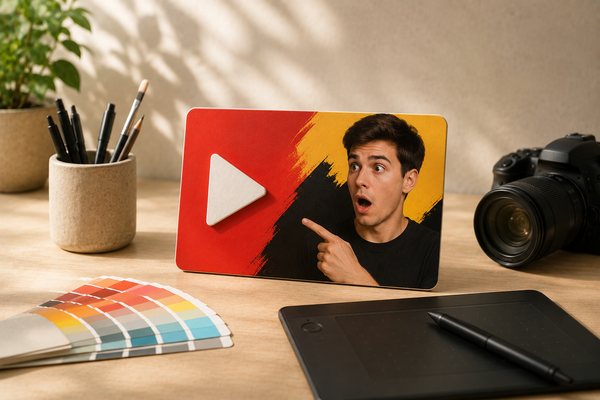
Your thumbnail and title must work together. If they send conflicting signals, viewers scroll past.
Common thumbnail killers (often cited as top mistakes):
- Too much text
- Low contrast
- Generic faces
- Designs that look like every other video in your niche
If CTR is the issue, swap the thumbnail. The algorithm will test the new one with fresh impressions. If you need objective eyes on your design, BerryViral rates your thumbnail for clickability and points out specific issues like contrast.
Step 2: Check your retention
If your CTR is decent but the video isn't being pushed, the problem is inside. Head to the engagement tab and look at your audience retention graph (learn to analyze retention curves here).
A sharp, straight decline from the start means your hook failed. Your intro is likely too slow or doesn't deliver on the title's promise. A healthy curve flattens out after the first 30 seconds.
- Sharp drop in the first 30 seconds: Your hook isn't working.
- Cliff at a specific timestamp: Something is driving people away. Watch that moment.
- Spikes: People are rewinding. Note what they liked and do more of it.
Step 3: Check your engagement
If CTR and retention are fine, look at engagement. If 10,000 people watch but nobody comments or likes, the content didn't move them. The algorithm notices this silence.
Low engagement usually means the content was informative but lacked an emotional hook, or you forgot to ask viewers to participate.
Step 4: Check your traffic sources
Look at the reach tab. If browse features is near zero, YouTube isn't recommending your video. This is a signal that your CTR or retention is too low to justify further distribution.
If even your own subscribers aren't clicking, your packaging problem is severe.
What you can actually do
If it's a packaging problem: Swap the thumbnail immediately. Use BerryViral to get feedback on why your design isn't clicking. Revise the title to be more specific.
If it's a content problem: Watch your video with fresh eyes. Note where you get bored. For your next video, address (but not reveal completely) the core value within the first 30 seconds. And then ensure a pattern of small unsolved questions and their resolutions until at the very end where you reveal the full core value as promised.
If the video has been out for two weeks: Try a thumbnail swap. Add the video to a relevant playlist to give it a new discovery surface.
Build a diagnostic habit
Don't just fix one video. Run this 15-minute post-mortem every time (as discussed by creator communities):
- Is CTR below my average?
- Where does the retention curve drop?
- Did my subscribers click?
- What is one thing I will test differently next time?
Growth happens when you iterate based on data, not luck. Fix the packaging, study the retention, and repeat. That is the whole game.