Why Better Videos Don't Always Get More Views on YouTube


You're making better videos. Why are your views still flat?
You spent all weekend editing your best video yet. The audio is crisp, the pacing is tight, and the information is useful. You hit publish. Then... 47 views in two weeks, 30 of which are just you refreshing the page.
Sound familiar? YouTube doesn't reward quality. It rewards signals. If you miss that, you will keep making great videos that nobody watches.
The algorithm is not a film critic
Many creators assume that if they make something good, the algorithm will eventually find it. That is a mistake. Don't listen to advice from larger creators who already have an audience doing the heavy lifting for them.
YouTube is a prediction engine. Its job is simple: if I show this video to this person right now, will they click, watch, and feel satisfied? It doesn't grade your production value or research depth. It looks at behavioral signals—clicks, watch time, and whether viewers stay on the platform after your video ends.
A technically average video with a magnetic thumbnail and a title that hits viewer intent will beat a beautifully produced video with a bland thumbnail every time.
The first gate: Impressions and CTR
Before your video gets views, it needs impressions. YouTube has to show your thumbnail to someone. Before impressions grow, your video must pass an initial test.
When you upload, YouTube shows your video to a small sample audience. Based on how that group responds—do they click? do they watch?—YouTube decides whether to push the video further or let it fade. If your thumbnail and title don't generate enough clicks, YouTube assumes the video isn't interesting, and your impressions stay low.
This is why low impressions is a common complaint. The content quality never gets evaluated because the packaging failed the first test.
What "Quality CTR" actually means
YouTube doesn't just reward a high click-through rate (CTR) alone. In 2026, the algorithm evaluates Quality CTR—a mix of clicks and what happens in the 30 seconds after the click (source).
A video with a 10% CTR that loses 80% of viewers in the first minute is worse for your channel than a video with a 5% CTR where viewers watch 70% of the content. The algorithm knows when a thumbnail makes a promise the video doesn't keep. That kind of clickbait gets demoted.
Don't trick people. Create a thumbnail and title that represents interesting content—and then deliver on that promise.
Browse features and suggested videos
Most views for growing channels don't come from search. They come from browse features—the home page, the suggested sidebar, and the subscriptions feed (source).
The home feed is YouTube's biggest distribution mechanism. Your video can appear here even if someone has never heard of your channel, but only if your packaging is strong enough to earn clicks when tested against that audience.
Suggested videos work similarly. If your content is topically related to popular videos in your niche and your thumbnail earns clicks, you can appear alongside much larger channels.
Why small channels have a real shot
The algorithm doesn't favor big channels over small ones. Small channels get tested aggressively when early signals are strong (source). If your first few videos generate solid CTR and retention, YouTube will expand your reach faster than it would have a few years ago.
The barrier isn't time or subscriber count. The barrier is whether your thumbnail and title are compelling enough to earn clicks from strangers who have no reason to trust you.
The real reason your video gets no views
You are asking yourself why your video gets no views and assuming it's because you haven't been at it long enough or the algorithm is unfair. Usually, the answer is simpler: your thumbnail isn't stopping the scroll.
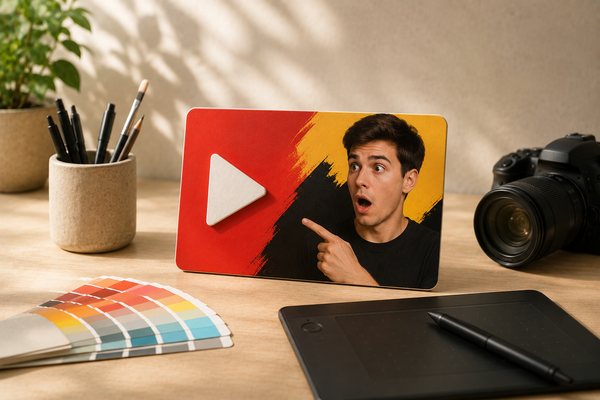
Think about how you use YouTube. You don't deliberate—you react. High contrast, a clear focal point, an expressive face, and text that sparks curiosity make you pause. A screenshot with text slapped on it won't compete with intentional design. If your thumbnail doesn't earn clicks, YouTube stops pushing your video.
How to fix this
- Audit your thumbnails. Look at your thumbnails next to the competition. Are they as visually striking? Is the focal point clear?
- Check your CTR by traffic source. If your search CTR is decent but your browse CTR is low, your thumbnail isn't compelling enough for cold audiences (source).
- Hook viewers in the first 30 seconds. The algorithm watches early drop-off closely. If you lose people immediately, your reach gets suppressed.
- Study what's working. Look at videos with high view counts relative to the channel's size. Figure out what their packaging has in common.
- Iterate on packaging. Spend more time on your thumbnail. It is the first thing that determines whether anyone sees the video.
This is the problem BerryViral solves. Instead of taking blind shots on your own, you can get your thumbnails rated for clickability with specific feedback on contrast, readability, and composition. You can even generate improved versions or full concepts with a single click. It's the kind of help that makes the difference between a video that gets buried and one that earns its way into the browse feed.
The bottom line
Better videos don't automatically get more views because YouTube evaluates viewer behavior, not your production quality. The thumbnail and title determine whether your video gets a fair chance. If that first step fails, the quality of everything that comes after is irrelevant.
Fix the packaging, earn the click, and deliver on the promise. That's the loop the algorithm rewards.