
How Much Does YouTube Pay for 10K, 100K & 1M Views? Real Earnings Explained

The number everyone wants to know
If you have ever watched your view count climb, you have done the math. You wonder what 100,000 views actually pays. It is a common question, but the answer is never a single, flat number.
Here is the reality of how YouTube pays, what you can expect at different milestones, and what moves the needle on your paycheck.
YouTube does not pay per view
Many new creators get this wrong. YouTube does not pay you for every person who watches your video. You earn money when people watch or engage with the ads on your content.
You need to track two metrics: CPM and RPM.
- CPM (Cost Per Mille): What advertisers pay YouTube for 1,000 ad impressions. This is the gross number before YouTube takes its cut.
- RPM (Revenue Per Mille): What you take home per 1,000 video views after YouTube keeps its 45% share.
In 2026, average CPM rates hover between $2 and $12. Creator RPM usually lands between $2 and $6. That gap is YouTube's commission. Also, not every view generates an ad. Roughly 49–68% of views result in an ad, depending on your audience and content.
If you see someone claim "YouTube pays $18 per 1,000 views," they are in a high-paying niche. Your experience will differ.
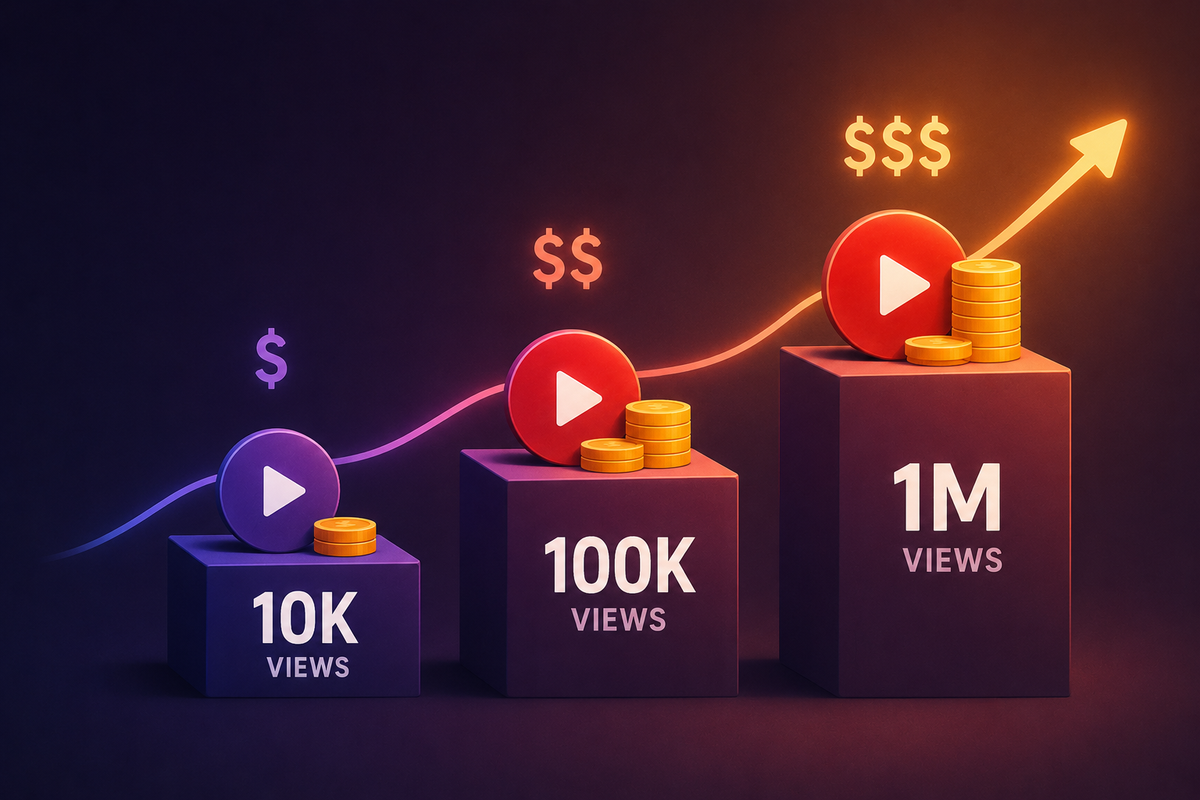
How much does YouTube pay for 10,000 views?
At 10,000 views, expect $25 to $100. That range exists because your niche and audience location matter.
A gaming channel hitting 10K views might earn $20–$40. A personal finance channel could pull in $80–$150 because finance advertisers pay more per impression. At an average RPM of $3–$5, the math is simple:
- 10,000 views × $3 RPM = $30
- 10,000 views × $5 RPM = $50
- 10,000 views × $10 RPM = $100
10K views is a start, but it won't pay the rent. Focus on consistency and a higher click-through rate at this stage.
How much does YouTube pay for 100,000 views?
At 100K views, the money starts to feel real. Most creators earn between $200 and $1,000 per video, as noted in industry breakdowns.
- 100,000 views × $2 RPM = $200
- 100,000 views × $5 RPM = $500
- 100,000 views × $10 RPM = $1,000
A video hitting 100K views in a mid-tier niche like cooking or education usually lands between $300–$600. Business or legal content can easily push past $1,000.
This is where your thumbnail and title show their value. A compelling thumbnail that pushes your CTR from 4% to 8% can double your earnings compared to a video that stalls at 50K views.
How much does YouTube pay for 1 million views?
This is the big milestone. 1 million views on a long-form video typically earns between $1,000 and $5,000, with most creators hitting the $2,000–$3,500 range.
- 1,000,000 views × $2 RPM = $2,000
- 1,000,000 views × $3.50 RPM = $3,500
- 1,000,000 views × $5 RPM = $5,000
High-end niches like personal finance or B2B software can see RPMs of $15–$22, putting 1 million views at $15,000–$22,000. That is not the norm, but it happens if you have the right audience.
What about YouTube Shorts?
Shorts pay less. Monetization works through the Creator Pool, where ad revenue is shared based on your portion of total Shorts views.
1 million views on Shorts earns roughly $30–$100. TubeBuddy data confirms Shorts RPM is usually $0.03–$0.07. You need 20–100x more views on a Short to match what a long-form video earns. Use Shorts to grow your subscriber base, but rely on long-form content for direct ad revenue.
Quick reference: YouTube earnings by view count
- 10,000 views: $25 – $100
- 100,000 views: $200 – $1,000+
- 1,000,000 views: $1,000 – $5,000
- 1,000,000 Shorts views: $30 – $100
8 factors that determine your pay
Your view count is just the start. Here is what moves your RPM:
1. Your niche
Finance, software, and legal content pay more than entertainment or gaming.
2. Audience location
Advertisers pay a premium to reach viewers in the US, Canada, Australia, and the UK. A video with 100K views from a US audience will out-earn a video with 200K views from a global, mixed audience.
3. Video length
Videos over 8 minutes allow for mid-roll ads. A 15-minute video can run 3–4 ads, while a 4-minute video usually serves only one.
4. Seasonality
Q4 (October–December) is the highest-paying time of year because advertisers spend heavily for the holidays. January is usually the lowest.
5. Click-through rate
If people click your thumbnail, YouTube shows your video to more people. A better thumbnail means more views and more money.
6. Viewer engagement
Viewers who watch the whole video generate more revenue than those who skip everything.
7. Ad type
Non-skippable ads pay more than skippable ones.
8. Timing
Earnings depend on when the views happen. Evergreen content earns less in January than it does in November.
How to start making money
You must join the YouTube Partner Program (YPP) first. Requirements include 1,000 subscribers and either 4,000 public watch hours or 10 million Shorts views in 90 days. Note that the watch hour requirement doubles to 8,000 in early 2027.
Beyond AdSense
Successful creators rarely rely on ad revenue alone. They earn through sponsorships, affiliate marketing, digital products, and direct fan support. Ad revenue is the baseline, but sponsorships often provide the real income.
How to increase your earnings
You have two levers: increase your RPM by targeting high-paying niches, or increase your views by improving your CTR. Your thumbnail is the first thing a viewer sees. If it fails, the video fails.
Tools like BerryViral help you test your thumbnails before you post. When your thumbnail gets more clicks, your views climb, and your earnings follow.
The bottom line
YouTube pays, but it takes time to scale. 10K views might get you $50, while 1 million views can net you thousands. Focus on high-CPM niches, target the right audience, and treat your thumbnail as the most important part of your video strategy.