How YouTube Monetization Works & What It Really Pays in 2026

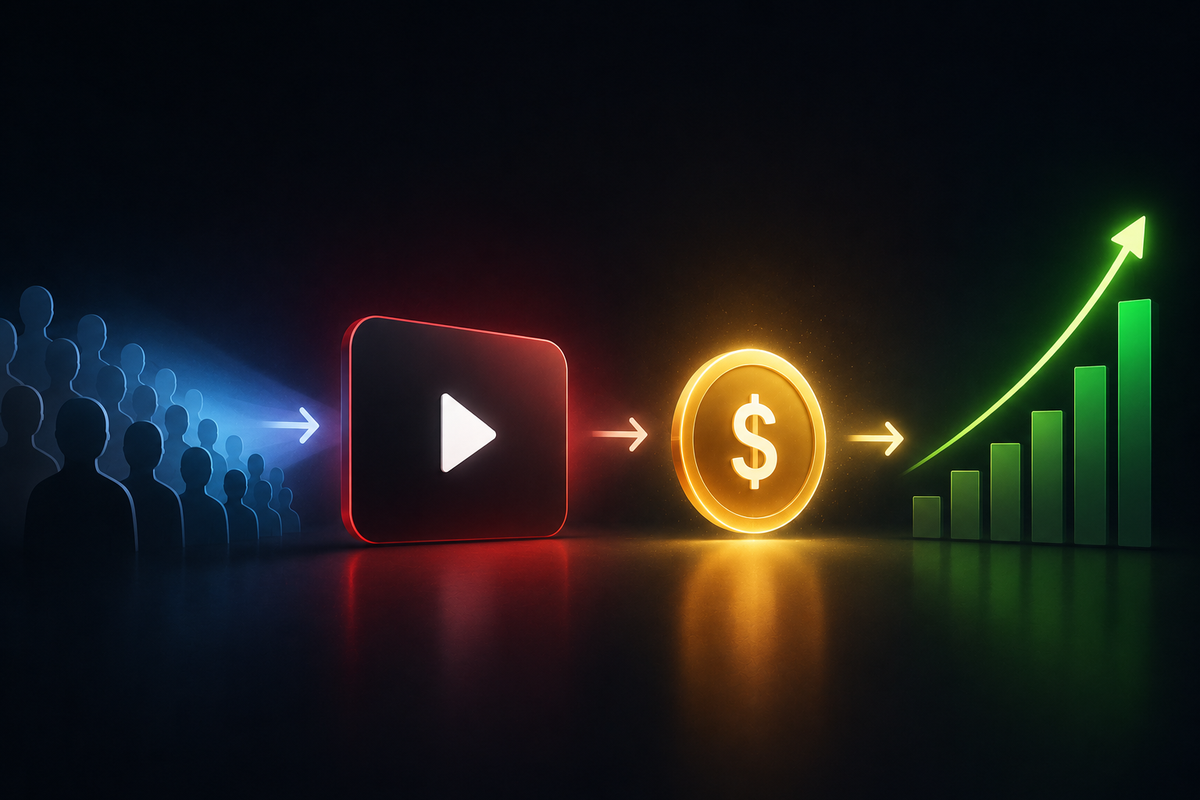
How YouTube monetization works
If you have ever searched for "how much does YouTube pay per view," you probably walked away more confused than when you started. The answer is simple: it depends. I will break down the math, show you real numbers, and explain how money moves from an advertiser's budget into your bank account.
I have been on this platform long enough to watch the system evolve. In 2026, you have more ways to earn than ever.
The YouTube Partner Program (YPP)
Many creators think monetization is one single gate. It is actually a two-tier system.
Tier 1 — Fan funding (500 subscribers):
- 500 subscribers.
- 3,000 watch hours in the last year or 3 million Shorts views in 90 days.
- 3 public uploads in 90 days.
This unlocks Super Chat, Super Thanks, channel memberships, and YouTube Shopping. You do not get ad revenue here, but these features can generate cash before you hit the main threshold.
Tier 2 — Full monetization (1,000 subscribers):
- 1,000 subscribers.
- 4,000 watch hours in the last year or 10 million Shorts views in 90 days.
This unlocks ad revenue sharing and YouTube Premium payouts. Apply through the Earn tab in YouTube Studio, connect an AdSense account, and wait for approval.
CPM vs. RPM: The numbers that matter
CPM is what advertisers pay YouTube for 1,000 ad impressions. This is the gross number before YouTube takes its cut.
RPM is what you actually earn per 1,000 views. This is the only number that matters.
YouTube keeps 45% of ad revenue and gives you 55%. Because not every viewer sees an ad, your RPM will always be lower than the CPM. YouTube estimates ads show on about half of all views.
Here is the reality for 2026:
- Average global CPM: ~$3.50.
- Average RPM range: $2–$11 per 1,000 views.
- US long-form average RPM: ~$10.81.
Niche and geography change everything
Advertisers pay more for audiences they value. A viewer watching a mortgage video is worth more than someone watching a gaming clip.
Estimated CPM by category:
- Finance & Investing: $15–$50.
- Tech & Software: $10–$20.
- Gaming: $4–$15.
- Entertainment: $3–$8.
Geography matters just as much. Advertisers pay a premium to reach high-income countries. A US-based audience can earn you 40x more than an audience in a country with lower advertising budgets. Detailed rate breakdowns show significant variance by region.
How you get paid
Once you are in the YPP, the payment flow is simple:
- YouTube tallies your earnings monthly.
- Finalized numbers appear around the 10th of the next month.
- Payments hit your bank between the 21st and 26th.
- You must hit a $100 minimum to trigger a payout. If you earn less, it rolls over to the next month.
Ad revenue is just one piece
Successful creators do not rely solely on ads. They treat YouTube as a platform for multiple income streams:
- YouTube Premium: You get a share of subscription fees based on watch time.
- Direct fan payments: Super Chat, Super Thanks, and memberships.
- YouTube Shopping: Link products directly to your videos.
- Sponsorships: Brands pay you directly for integrations. This is often the biggest paycheck for mid-sized channels.
- Affiliate marketing: Earn commissions on products you recommend.
- Your own products: Courses, templates, or consulting. This is often more profitable than ad revenue.
The hidden multiplier: CTR
Your click-through rate (CTR) is a multiplier for everything. If you improve your thumbnail and your CTR jumps from 4% to 6%, the algorithm pushes your video to a wider audience. More eyeballs mean more revenue.
If you need help here, TubeBuddy provides tools for thumbnail contrast, text, and composition. It can even generate new concepts for you. It is a tool that pays for itself once your videos start breaking out.
The bottom line
To hit that $100 payout in your first month at a $3 RPM, you need roughly 33,000 views. It is not passive income from day one, but the money is real. YouTube paid creators over $100 billion in recent years. Treat your channel like a business, diversify your income, and keep optimizing your thumbnails. That is the only playbook that works.