Why Your YouTube Video Views Flatline After 10K & How to Fix It

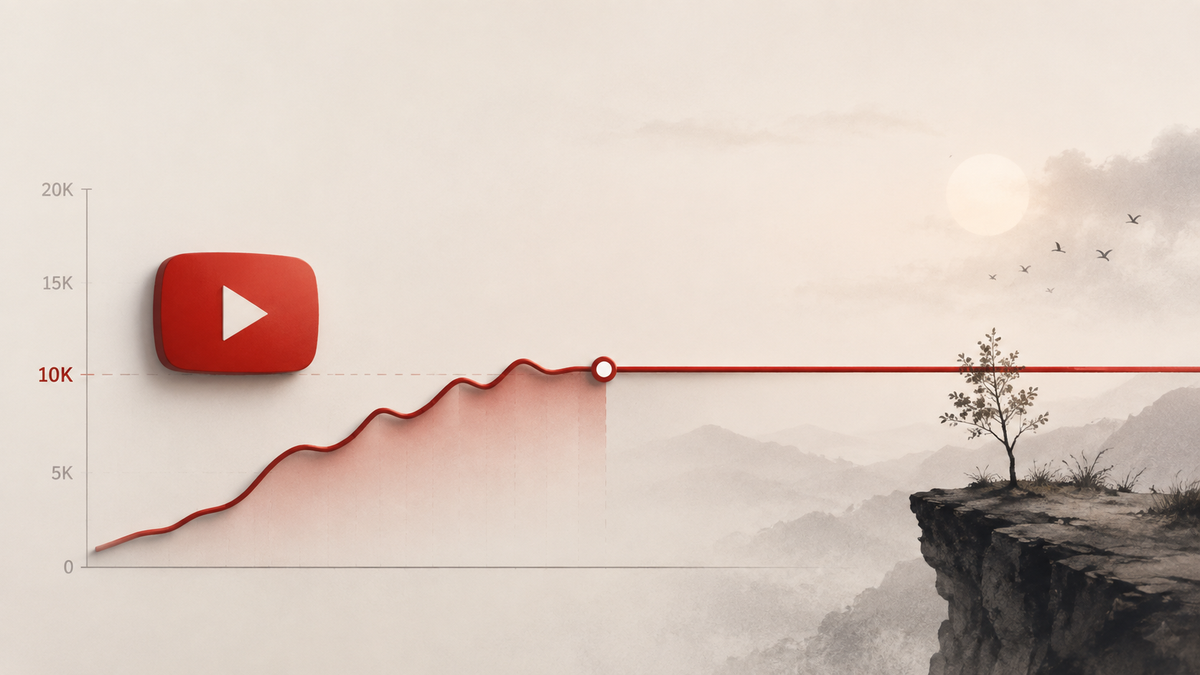
You upload a video. The first 48 hours are often critical. Views climb, notifications pop, and you refresh your dashboard like a gambler. Then, right around 10,000 views, the graph goes horizontal. It stops dead. If this happens to you, don't blame the algorithm. It isn't a moody entity, just some math...
How YouTube tests your videos
YouTube doesn't blast your video to millions at once. It runs a test. It shows your work to a small sample—usually your subscribers—and watches what happens. The system checks two things: did they click, and did they watch? If both signals are strong, it expands the test. That 10K wall means your video passed the test with your core fans but failed the wider test with strangers. The algorithm pulled back because the data didn't justify more impressions.
The CTR threshold
Click-through rate (CTR) is the first filter. If people ignore your thumbnail, YouTube assumes your content is irrelevant. Videos with a CTR below 10% often struggle to gain traction, while the best-performing videos typically hit 13–20%. If your CTR drops below 3%, YouTube stops showing your thumbnail to new audiences entirely. Why does this happen at 10K? Your subscribers trust you and click anything. Once the video hits a cold audience, your thumbnail has to do the heavy lifting. If it fails to grab a stranger, your CTR tanks, and the algorithm drops you.
The watch time trap
Even if your thumbnail is solid, you aren't safe. The second signal is retention. If your retention drops below 30%, the algorithm assumes your content failed its promise. High CTR coupled with low watch time looks like a bait-and-switch, which hurts distribution more than a moderate CTR ever would. If your title makes a promise but your video takes too long to deliver, viewers bounce within 30 seconds. Most videos lose 20-35% of viewers in that first half-minute. If you waste that time with a long intro or a request to subscribe, you are training the algorithm to kill your video.
Satisfaction signals
Since 2025, YouTube has tracked more than just clicks and watch time. It now looks at:
- "Not Interested" clicks
- Rewatches
- Playlist saves
- Session duration after watching
- Direct satisfaction surveys
A video can have decent watch time but still generate low satisfaction if viewers felt they had to grind through it. YouTube knows the difference between someone who was engaged and someone who just gave up.
Can you revive a dead video?
Yes. Changing your thumbnail after 24 hours can trigger the algorithm to re-test the video with a fresh set of impressions. If the new thumbnail performs better, it can restart distribution. This works best if the video is recent. You can't fix a boring hook, but if the content is solid and the thumbnail was the weak link, changing it is worth the effort.
What to fix
- Fix the thumbnail first. If people don't click, nothing else matters. Tools like BerryViral can rate your thumbnail for clickability.
- Audit your hook. Check your retention graph. If there is a cliff in the first 30 seconds, your intro is too slow. Cut the preamble.
- Check title-to-content alignment. Your video must fulfill the promise of the title immediately.
- Re-hook throughout. Give viewers a reason to keep watching every 60-90 seconds.
- Update old thumbnails. If a recent video has a CTR below 5%, change the image and watch for a bump in impressions.
Stop blaming the algorithm
The algorithm is a mirror. When your video stops getting views, it’s telling you that your thumbnail failed to attract strangers or your content failed to keep them. The 10K flatline isn't a death sentence; it’s a diagnosis.